
In partnership with

Welcome to Billion Dollar Energy. I went from a farm town in Canada to a Silicon Valley insider and venture capitalist. I share secrets and insights to help you build wealth, legacy, and freedom.
Forwarded this email? Join 50,000+ other professionals every Wednesday.
Billion Dollar Energy is brought to you by:
The ones showing up in LLMs convert 3× better than Google

They optimized for LLMs, not just Google.
FAQs. Comparison pages. Transparent pricing. LinkedIn presence. These aren't vanity plays. They're what gets you cited in ChatGPT, Gemini, and Claude when your buyers are researching, your investors are looking, and your future hires are deciding where to work.
Download the free AEO Playbook for Startups from HubSpot and get the exact checklist. Five minutes to read.
Ready to meet in real life?
It’s time to meet your people.

Join us for the first-ever billion dollar walk in Santa Monica on Sunday, April 26th. Meet other future-thinking professionals, entrepreneurs, and creators who are ambitious about building a life of freedom and legacy.
Book a time to speak with me 1:1.
Interested in coaching on venture capital, running your businesses, public speaking, or growing your network? Book a time for us to connect.
Last month, I wrote about navigating job loss in the age of AI. It became one of my most-shared pieces ever.
Since then, the data has gotten worse.
On April 1st, Oracle sent a 6 AM email to up to 30,000 employees. The message was signed "Oracle Leadership." The email was completely nameless. Some thought it was an April Fools' joke.
It wasn't.
The number no one's talking about.
The median time to re-employment for a laid-off tech worker increased from 3.2 months in 2024 to 4.7 months in early 2026. That's a 47% longer job search.
And when they finally land? Goldman Sachs says they're taking about a 3% pay cut through "occupational downgrading," moving into roles that require fewer of the skills they spent years building.
If you're a millennial like me, this probably sounds crazy. You were told your whole career to job hop. Switch every two years. Chase the raise.
It worked. Until it didn't.
This isn't the first time workers have taken a pay cut after displacement. It happened in the 1980s when inflation eroded wages. Then, it happened again after the Great Recession, when displaced workers saw earnings drop 48% and never fully recovered.
But here's what's different: in past downturns, the economy eventually recovered and demand for those skills returned. This time, the skills themselves are being devalued. They will likely never be in demand again.
The math no one’s doing.
Inflation hit 3.3% in March.
If your last salary was $150,000, your new salary is about $145,000.
But with 3.3% inflation, that $145,000 buys what $141,000 bought last year.
That's nearly a $9,000 loss before you even start.
And it compounds. Your raises, your bonuses, and your next negotiation are all anchored to a lower baseline. We're talking hundreds of thousands in lost lifetime earnings.
The numbers are accelerating.
Since the beginning of the year, more than 500 tech workers have been laid off every day. Yes, every single day. That’s 78,000 people. Of those layoffs, nearly half were attributed to AI.
In March, AI was the top reason employers gave for tech layoffs, accounting for 25% of cuts. Only a month earlier, the figure was 10%.
Block cut 40% of its workforce, and the stock jumped 24%. Oracle's 30,000 cuts are being redirected to AI data centers. Other major employers are expected to make cuts, too.
Jack Dorsey was direct: "The intelligence tools we're creating, paired with smaller and flatter teams, fundamentally change what it means to build and run a company."
They're not being subtle anymore.
So, what do you actually do?
Audit yourself before your company does. Sit down and figure out what you do that AI can't. If you can't make a compelling list, your manager won't be able to either when they're deciding who to keep.
Build income your employer can't touch. Start a newsletter, pick up consulting clients, buy real estate, or invest aggressively (I do all four). The goal isn't to quit your job. The goal is to make sure you're not destroyed if your job quits you.
Use AI before AI replaces you. Spend one hour a day doing real work with these tools, not just watching tutorials. The gap between people who use AI well and people who don't is about to become the gap between employed and unemployed. I’m even doing it with my kid.
Build a network that picks up the phone. Not LinkedIn connections, but actual relationships with people who will vouch for you, refer you, and text you back. You might need these people sooner than you think (I wrote about why this is a secret to my own success a few weeks ago).
So, now what?
The Oracle layoffs were announced via email signed by "Oracle Leadership." No executive put their name on it.
That tells you everything about how companies are thinking about this moment.
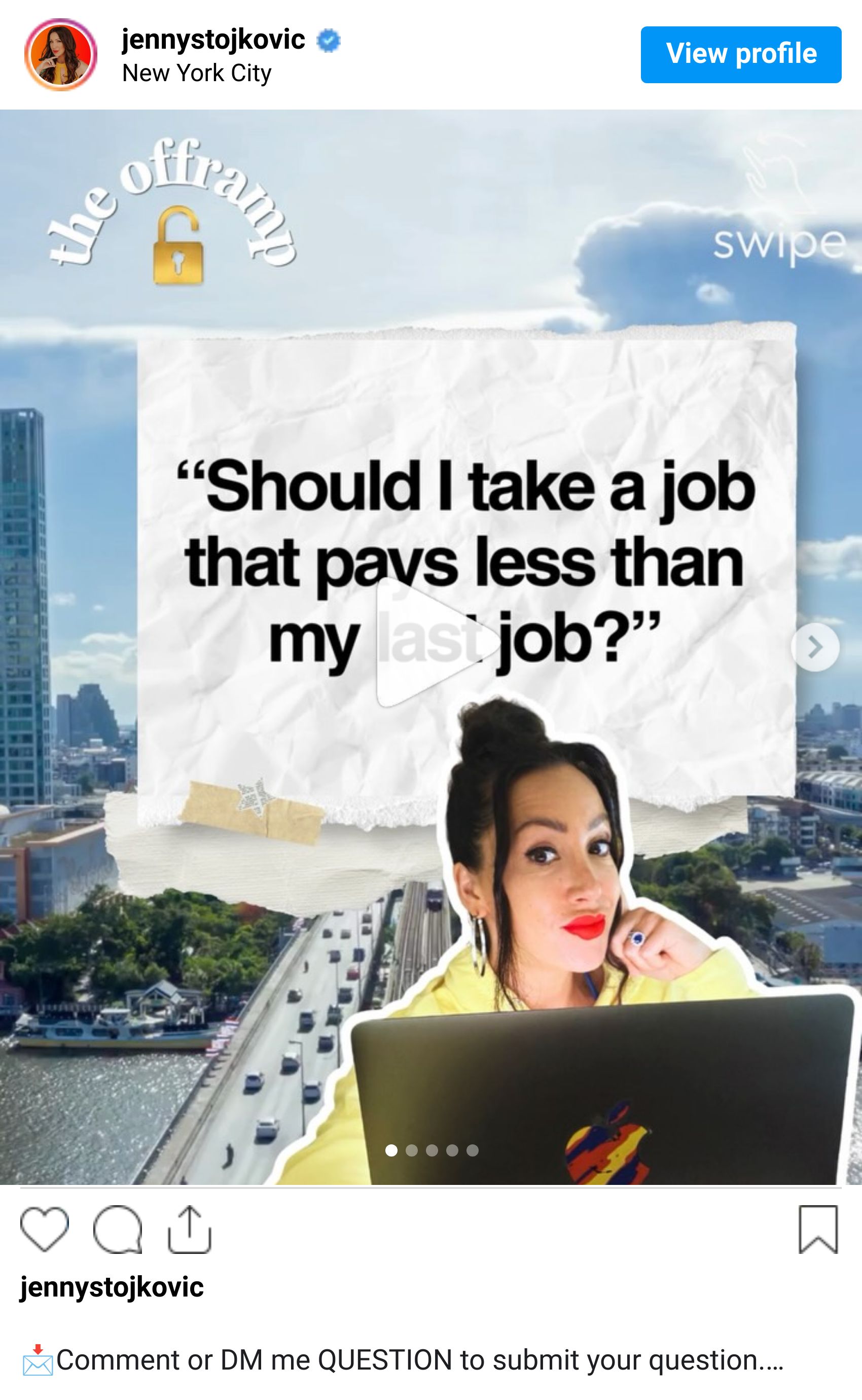
That’s why you need to build an offramp. Build skills, build income streams, build a network of people who will take your call. Do it now, so that when the email comes, you're ready.
The only person who can protect your career is you.
Hit “reply” and tell me what you’re doing to build your offramp this year.
Jenny

Shared this email? Subscribe here.