
Welcome to Billion Dollar Energy. I went from a farm town in Canada to a Silicon Valley insider and venture capitalist. I share secrets and insights to help you build wealth, legacy, and freedom.
Forwarded this email? Join 45,000+ other professionals every Wednesday.
Billion Dollar Energy is brought to you by:
Subscribe to my NEW YouTube Channel!
Got a busy schedule? I’m taking my popular billion dollar energy series to Youtube every week. Now you can listen to my full deep dive every week in the car, watch at the gym, and send it to friends!
Book a time to speak with me 1:1.
Interested in coaching on venture capital, running your businesses, public speaking, or growing your network? Book a time for us to connect.
Last week, I talked about how baby Roman is officially five months old. I’m lucky to report he is sleeping 12 hours during the night. Me, however? Post-partum insomnia.
That post-partum insomnia has led to some deep internet rabbit holes, and why I stumbled onto something I haven’t been able to stop thinking about. I want to tell you about it today (plus, test out a new deep dive format for today’s newsletter).
So, let’s get into it.
In the last 18 months, Sam Altman has quietly hired three women who previously ran billion-dollar companies. These women are the operational leaders running the most critical functions at OpenAI.
All three of them gave up CEO titles to be there.
Sometimes the dots start to connect while I’m fighting to stay awake.
Let me be clear about what I’m sharing here.
This is not “just” a story about how Sam Altman hired three of the most successful women in Silicon Valley, although that alone is worth writing about. There’s a deeper reason for this story.
Women in influential positions in AI might be a crucial factor for long-term AI alignment.
But before we get to that, let me introduce you to each of these leaders.
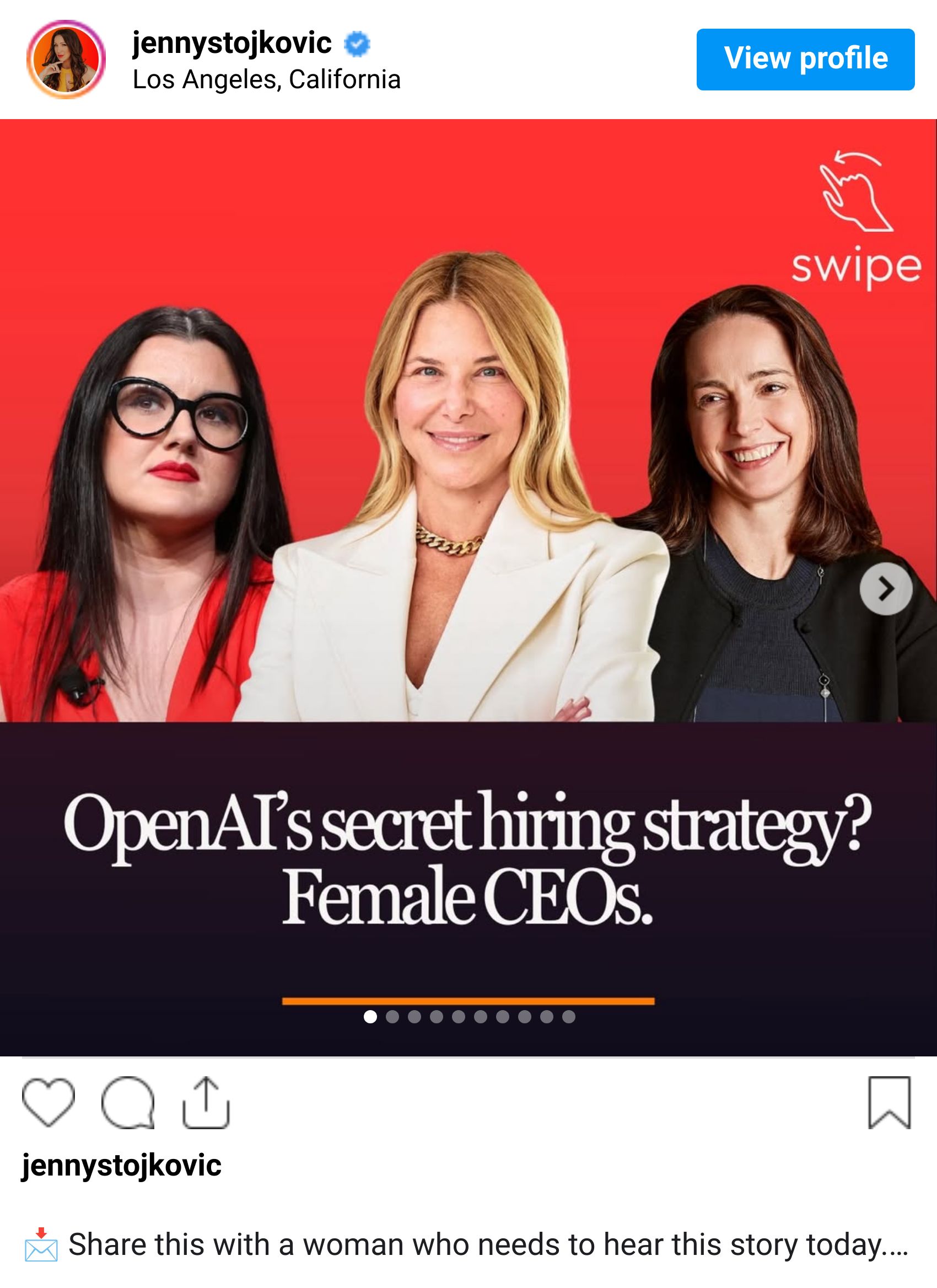
Fidji Simo: CEO of Instacart → CEO of Applications, OpenAI
Fidji Simo spent nearly a decade at Facebook, where she rose from product manager to running the entire Facebook mobile app. That’s a product used by 2.4 billion people.
She oversaw a team of over 6,000 employees and led the development of Facebook Live, Facebook Watch, and the autoplay video format that fundamentally changed how we consume content online (the jury’s out on whether that was a good thing).
In 2021, she left Meta to become CEO of Instacart. Two years later, she took the company public on the Nasdaq at a $10 billion valuation, breaking a 20-month tech IPO drought that had frozen Silicon Valley.
In May 2025, Sam Altman hired Fidji and created a role that had never existed at OpenAI before: CEO of Applications. She now runs product, business, and engineering across all of OpenAI’s consumer-facing products, including ChatGPT.
Think about that. The person who scaled one of the most-used apps in human history, then built and IPO’d a major tech company, is now the person deciding how the most powerful AI on the planet gets put into your hands.
Denise Dresser: CEO of Slack → Chief Revenue Officer, OpenAI
Denise Dresser spent over 14 years at Salesforce, rising to President of Accelerated Industries Sales. She built and scaled some of the largest enterprise deals in the company’s history.
In November 2023, she was named CEO of Slack, taking the reins of one of the most important workplace communication platforms in the world. She focused on integrating AI tools into Slack and positioning it as a platform where AI agents could help workers move faster.
In December 2025, she left Slack to join OpenAI as its first-ever Chief Revenue Officer. Her job: turn ChatGPT from a product people love into a revenue engine that can sustain the most expensive technology project on earth.
Sarah Friar: CEO of Nextdoor → CFO, OpenAI
Sarah Friar grew up in a small town in Northern Ireland. She studied metallurgy and economics at Oxford, got her MBA at Stanford, then spent over a decade at Goldman Sachs leading technology equity research. After Goldman, she became SVP of Finance and Strategy at Salesforce before landing the role that would define her career: CFO of Square.
She led the company’s IPO in 2015 and helped add $30 billion in market capitalization. From there, she became CEO of Nextdoor, growing the neighborhood social network to nearly 88 million users. She was awarded an OBE by Queen Elizabeth II for services to entrepreneurship.
In June 2024, OpenAI brought her in as its first-ever CFO. Her job? Navigate the most complex corporate restructuring in Silicon Valley history: converting a nonprofit into a $300 billion company. She closed OpenAI’s $40 billion funding round, the largest private tech raise on record, and oversaw the creation of a restructured entity that includes a $130 billion nonprofit endowment. By the way, that’s larger than Harvard, Yale, Princeton, Stanford, and MIT combined.
When asked about the scale of what OpenAI is building, Friar told CNBC: “It’s more like the railroads or the buildout of electricity than anything I’ve seen.”
They all gave up CEO titles.
Let’s sit with this for a second.
Fidji Simo left as CEO of Instacart. Denise Dresser left CEO of Slack. Sarah Friar left CEO of Nextdoor. None of them became CEO at OpenAI. In a world where titles are currency, three of the most accomplished women in tech voluntarily traded theirs in.
There’s a famous line from Eric Schmidt, then Chairman of Google, to Sheryl Sandberg when she was considering leaving Google for a tiny startup called Facebook: “If someone offers you a seat on a rocket ship, don’t ask what seat. Just get on.”
These three women didn’t ask what seat – they just got on.
And that tells you everything about how big they believe this moment is. These are not people who need OpenAI on their resume. They came because they believe AI is the most consequential technology of our lifetime, and they want to be the ones shaping how it reaches the world.
The deeper signal behind the signal.
Here’s the thing people keep missing about this story.
Sam Altman didn’t hire three women for optics. He hired three women because the data has been screaming the same thing for years, and most of Silicon Valley has been too stubborn to listen.
What’s more, this is far from the beginning of the stratospheric rise of women in AI – Daniela Amodei has been making waves since co-founding $600B competitor Anthropic, while OpenAI’s ex-CTO Mira Murati has gone on to build her own company. Let’s also not forget the startups sprouting from Google’s former Head of AI Fei-Fei Li, former Anthropic leader Andi Peng, and former Dropbox leader Kanjun Qiu.
S&P Global research found that in the two years following a female CEO appointment, companies saw a 20% stock price bump over those that appointed men. Women-led companies in the S&P 500 have dramatically outperformed their male-led counterparts over the past decade. And yet, as of 2025, women still lead only about 11% of Fortune 500 companies.
The talent pool is absurdly deep. The data is loud and clear. Still, I think there’s an even deeper story here that goes beyond the numbers.
Geoffrey Hinton, the Nobel Prize-winning scientist who quit Google to warn us about the technology he helped create, said something last year that stuck with me. He said AI will surpass human intelligence. And that the only model we have of a more powerful intelligence choosing to protect a less powerful one is a parent and a child.
If he’s right (and I think he is), then the question of who builds AI and what they value isn’t a nice-to-have. It’s the whole game.
The women leading AI right now aren’t leading because they’re women. They’re leading because they bring something the industry has been missing. The instinct to build things that don’t just scale, but that elevate humanity.
Why I can’t stop thinking about this.
As a VC, I spend my days writing checks into the future of technology. I sit across the table from the founders building it, I evaluate the companies shaping it, and I watch firsthand both the extraordinary promise and the terrifying uncertainty of what AI is becoming.
But I’m also a new mom. And every night, when I’m holding my son, I think about the world he’s going to grow up in. A world shaped by decisions being made right now, in rooms most people will never see, by people most people will never know.
That’s why this story matters to me. Because I’m a parent first.
The fact that the most powerful AI company on earth is putting women with proven track records in charge of how this technology gets built, sold, and financed? That gives me something I don’t feel very often when I think about the unsure future.
It gives me hope.
What do you think about OpenAI’s leadership moves? Does it change how you think about the future of AI?
And by the way, do you want to see more deep dive newsletters like this?
Hit reply and tell me. I read every response.
P.S. Know someone who needs to hear this story? Forward this email. The more people paying attention to who is building AI, the better.

Shared this email? Subscribe here.