
In partnership with

Welcome to Billion Dollar Energy. I went from a farm town in Canada to a Silicon Valley insider and venture capitalist. I share secrets and insights to help you build wealth, legacy, and freedom.
Forwarded this email? Join 50,000+ other professionals every Wednesday.
Billion Dollar Energy is brought to you by:
Voice dictation that doesn't mangle your syntax.

Most dictation tools choke on technical language. Wispr Flow doesn't. It understands code syntax, framework names, and developer jargon — so you can dictate directly into your IDE and send without fixing.
Use it everywhere: Cursor, VS Code, Warp, Slack, Linear, Notion, your browser. Flow sits at the system level, so there's nothing to install per app. Tap and talk.
Developers use Flow to write documentation 4x faster, give coding agents richer context, and respond to Slack without breaking focus. 89% of messages go out with zero edits. Free on Mac, Windows, and iPhone.
Do you want to learn AI in the next 30 days?
I recently launched a 30 day Women’s AI Challenge with other top women creators in AI. We’ll teach you everything you need to know in only 30 days for free — plus you can win prizes just for participating from sponsors like Airtable, Manus, Stan, Anything, and more! All are welcome, and it’s never too late to join!
Book a time to speak with me 1:1.
Interested in coaching on venture capital, running your businesses, public speaking, or growing your network? Book a time for us to connect.
Rapidly declining birth rates are a problem that I’ve written about before. Conventional wisdom is that less babies is surely a good thing, right? If nothing else, it means we would be able to slow our impact on the environment and the planet.
But most countries around the world have fallen well below the replacement rate, and that’s sending us towards a systemic crisis that would hit much sooner than people think.

U.S. births peaked in 2007 at 4.3 million. Then the financial crisis hit, and Americans stopped having babies at the same rate. The babies born in 2007 turned 18 this year, and every class after them has continued to get smaller and smaller.
Now colleges and universities are feeling the impact from this major shift. Higher education has known this was coming for nearly two decades. The "enrollment cliff" has been in every demographic forecast, every accreditation review, and every board meeting at every regional college in the northeast. It wasn't a secret. Everyone hoped something would change, and that birth rates would improve.
And yet, according to Bloomberg, each incoming class could now be smaller than the last. That financial pressure is going to be relentless for colleges and universities. It’s no longer a bad cycle to wait out, and has now become a relentless contraction of class sizes.
University numbers tell a clear story.
Sixteen nonprofit colleges closed in 2025. Eight more have already announced closures in 2026.
Penn State shuttered seven regional campuses. Hampshire College, which survived for 56 years, is done this fall. Anna Maria College, 80 years old, will close at the end of this semester. Since 2016, more than 100 U.S. colleges have closed or merged.
The ones going under aren't outliers with bad leadership. Most of them served their communities for over a century. They survived the Great Depression, two world wars, multiple recessions, and COVID. What they couldn't survive was a sustained, structural decline in the number of 18-year-olds.
It’s not just the birth rate.
Demographics are the floor falling beneath higher education. But two other forces are accelerating the drop at the same time.
The first is cultural. The perceived importance of college has hit a new low, and 29% of people now say the cost of a four-year degree is not worth it, regardless of loans. I’ve shared publicly multiple times that I don’t think my son, Roman, will ever need to go to college.
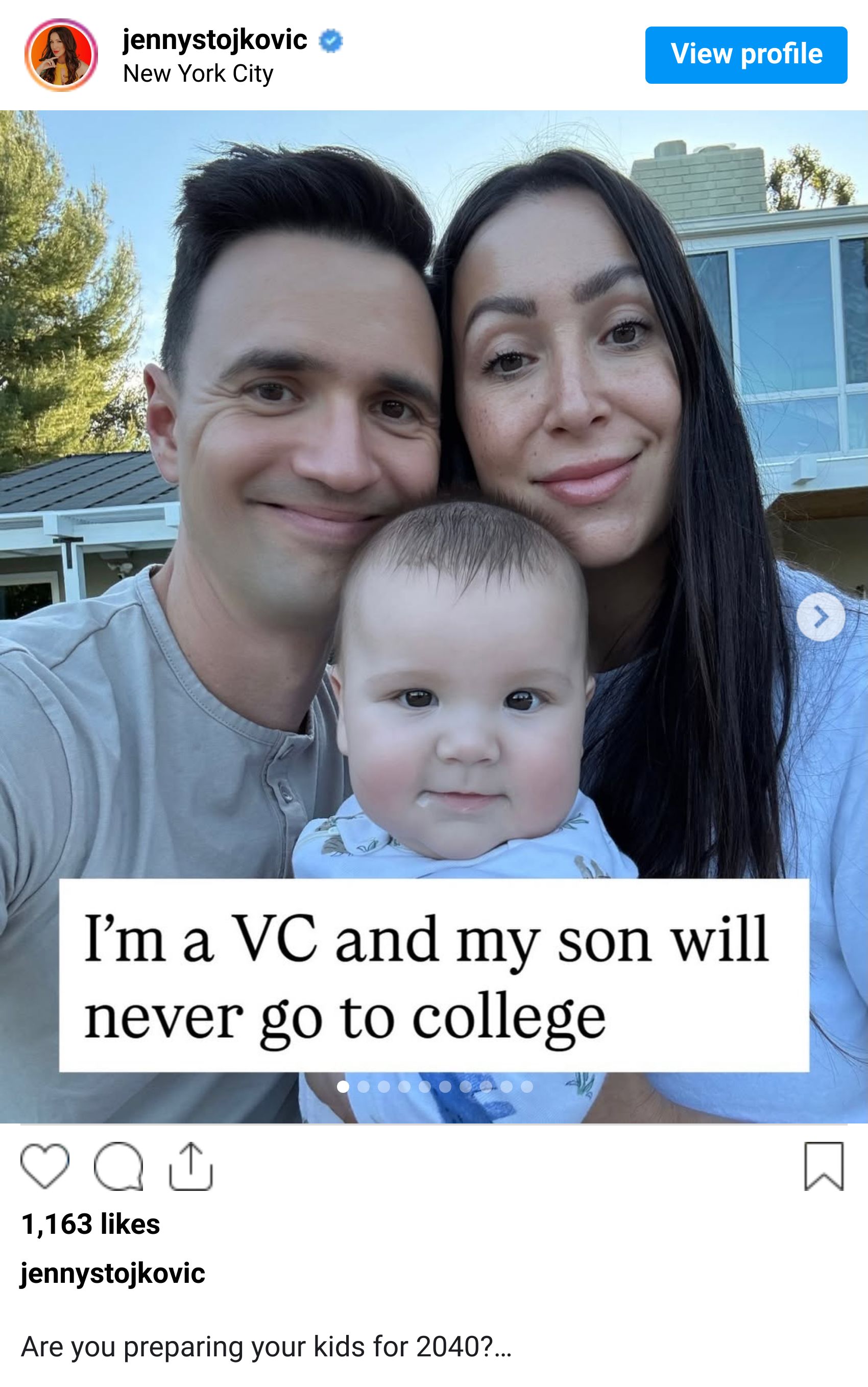
AI is creating viable career paths, as well as access to education, that didn't exist a decade ago. There are simply fewer believers that college is a good ROI. Why bother going into six figure debt by 21 years old when there’s no guaranteed, high-paying career path on the other end?
The second is political. For years, colleges have been quietly papering over domestic enrollment gaps with international students, who typically pay full tuition. Nearly 1.2 million were enrolled before this year, contributing $55 billion to the U.S. economy annually.
That backstop just got pulled. New international enrollment dropped 17% in fall 2025, the largest non-pandemic decline in over a decade. This spring it dropped another 20%, with graduate programs down 24%. 84% of institutions cited restrictive visa policies as the primary cause.
International students aren't disappearing. They're going to the UK, Canada, and increasingly China. 82% of institutions across Asia-Pacific and 47% in Europe reported growth in international enrollment this year. The U.S. had a near-monopoly on this market for decades. It is losing it in real time.
Three forces, demographics, culture, and policy, all moving in the same direction at the same time. None of them are reversing soon.
This isn’t evenly distributed.
The schools closing are not Harvard. Elite institutions are experiencing what economists call a flight to quality: five applicants for every seat, endowments in the billions. That world looks fine, for now.
The schools disappearing are the ones that educated the majority of people. I’m talking about regional four-year schools, small private colleges, and religiously affiliated institutions. The ones that gave first-generation students a path and employed hundreds of people in towns that had nothing else.
Each closure wipes out an average of 265 jobs and $67 million in annual economic activity. When they go, the community doesn't just lose a campus. It loses a hospital partner, an employer, a cultural anchor, and a reason for young people to stay.
Three shifts worth watching.
1. Alternative credentialing is about to have its moment.
The need that regional colleges were meeting isn't going away. Millions of people still want a structured path to a better job. Registered apprenticeships in the U.S. nearly doubled over the last decade, with employer-backed certification programs filling the gap in trades and tech. AI supercharges alternative forms of education even further.
2. College towns are mis-priced.
Real estate markets and regional economies built around a campus are pricing in a future that no longer exists. The Midwest and Northeast are the most exposed. If you're investing in or operating in those markets, the underlying demographic shift has to become part of your calculus.
3. The competition for students is now a global market.
The U.S. built its research universities and graduate programs on a pipeline of full-tuition international students. That pipeline is actively rerouting to competitors who are rolling out the welcome mat. The policy window to reverse this is closing. Every semester it continues, the reputational damage compounds and the habits of global applicants shift.
The institutions that survive this will be the ones that stopped waiting for the old model to come back and started building for who their student actually is today. And honestly? Maybe it’s for the best. Rapidly rising tuition prices and declining ROI’s have made higher education an unappealing proposition. It’s a painful market correction, but one that might be necessary given a bloated and expensive university system.
Hit reply and tell me: do you think higher ed is in a full structural collapse, or a painful correction that reshapes the industry? I read every single response.
Jenny
P.S. If you know someone considering higher education, send them this story. It’s not as obvious of a decision as it once was.

Shared this email? Subscribe here.