
In partnership with

Welcome to Billion Dollar Energy. I went from a farm town in Canada to a Silicon Valley insider and venture capitalist. I share secrets and insights to help you build wealth, legacy, and freedom.
Forwarded this email? Join 50,000+ other professionals every Wednesday.
Billion Dollar Energy is brought to you by:
Speak naturally. Send without fixing.

Wispr Flow turns your voice into clean, professional text you can send the moment you stop talking. Not rough transcription you have to clean up. Actual polished text — ready for email, Slack, or any app.
Speak the way you think. Go on tangents. Change your mind mid-sentence. Flow strips the filler, fixes the grammar, and gives you text that reads like you spent five minutes writing it.
89% of messages sent with zero edits. Millions of professionals use Flow daily, including teams at OpenAI, Vercel, and Clay. Works on Mac, Windows, and iPhone.
Do you want to learn AI in the next 30 days?
I recently launched a 30 day Women’s AI Challenge with other top women creators in AI. We’ll teach you everything you need to know in only 30 days for free — plus you can win prizes just for participating from sponsors like Airtable, Manus, Stan, Anything, and more! All are welcome, and it’s never too late to join!
Book a time to speak with me 1:1.
Interested in coaching on venture capital, running your businesses, public speaking, or growing your network? Book a time for us to connect.
A few weeks ago, I posted something that went viral. Then someone copied it.
When I say copied it, I don’t mean “took inspiration” — I mean, copied word for word. Full plagiarism.
Angered, I posted a video calling that out. That went viral, too. Half a million views.
The someone was Nicole Lapin. And what happened next surprised me.
She reached out to apologize. She explained that she had been using an AI writing tool that pulled from content it had been trained on, and neither she nor her team caught it before it went live. She didn't know it was my work. The tool never flagged it.
She reached out the right way, so we handled it the right way. We talked, we resolved it, and she had me on her podcast to tell the full story.

What could have been a public war became a real conversation about a problem the entire creator economy is going to have to reckon with.
I thought that was the end of it.
Then this weekend, it happened again.
A different account, Series Media, ripped off another one of my posts. I documented the whole thing here. This time, there was no outreach, no apology, no explanation. Just my work, on someone else's platform, building someone else's audience.
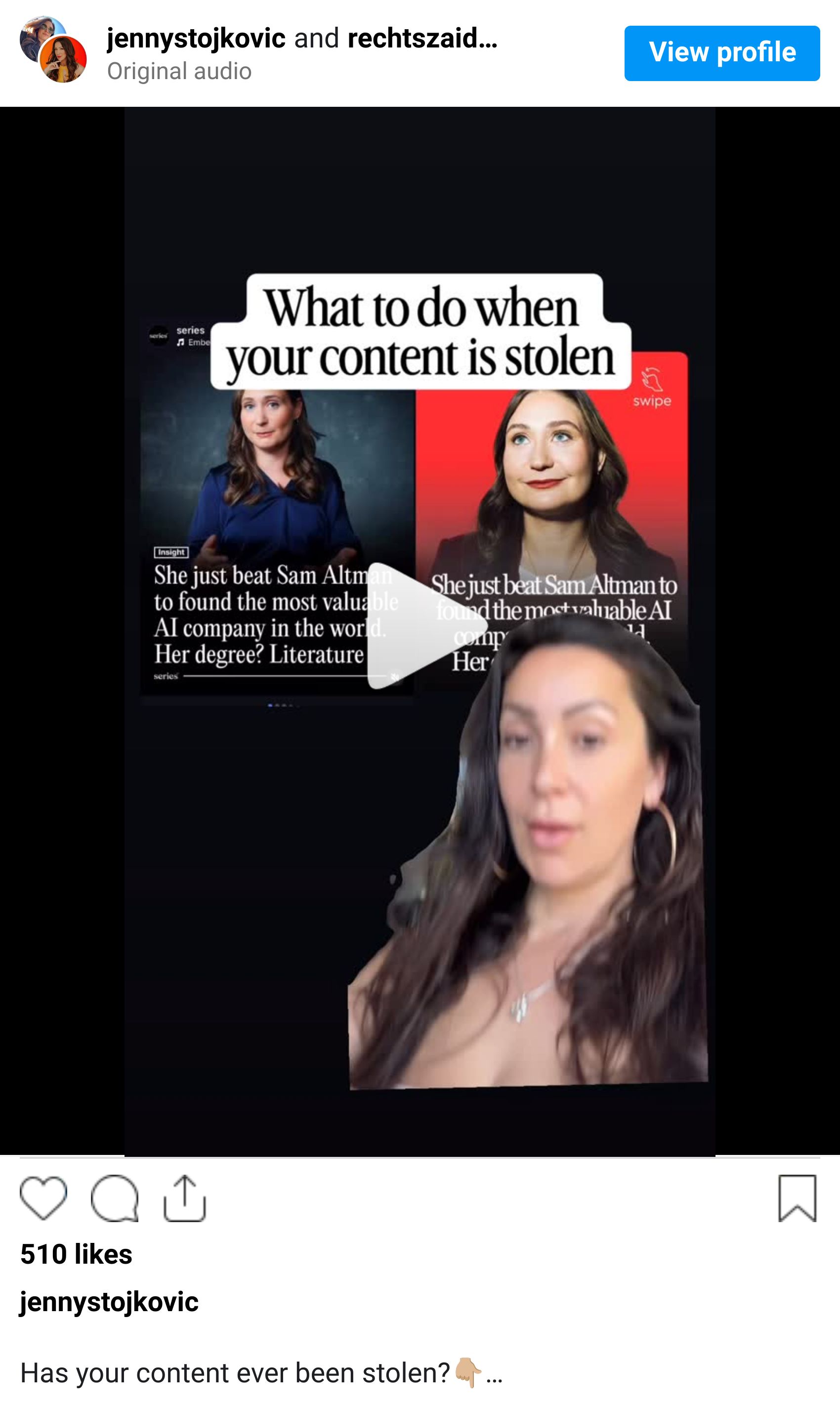
Two incidents in two weeks. I'm not writing this to complain. I'm writing it because if it's happening to me, it's happening to you, or it will.
This is the part of the AI conversation nobody is having. We talk about AI as a productivity tool, as a threat to jobs, as a competitive advantage. We're not talking about what happens when AI ingests a creator's original work and regurgitates it, without attribution, into someone else's content pipeline. At scale. Every day.
Your work is worth protecting. So I called in reinforcements. My friend Rebecca Rechtszaid is an entertainment attorney, founder of Rechtszaid Law, and former counsel for creators at Meta. Here's exactly what she says to do.
Step 1: Document before you do anything else.
Screenshot everything immediately, across every platform where the stolen content lives. Capture URLs, engagement numbers, and timestamps. Then pull your original files and make sure your creation dates and version history are intact. Your goal is to prove you were first, before anything gets edited or deleted. Tools like the Wayback Machine and Loom make this fast and free.
Step 2: Find out where you stand legally.
You own your copyright the moment you create something. No paperwork needed. But owning it and being able to enforce it in court are two different things. Copyright registration with the U.S. Copyright Office unlocks up to $150,000 in statutory damages per work infringed and gives you the legal right to sue at all. The filing fee is $65. If your most valuable content isn't registered, do it today.
Step 3: Issue a cease and desist.
You don't technically need a lawyer to write one, but a professional C&D carries far more weight. The moment it lands in their inbox, "I had no idea" stops being a defense. Include your identification as the copyright owner, a description of the original and infringing work, a specific takedown demand, and a deadline, usually 7 to 14 days.
Step 4: File platform takedown notices.
Submit DMCA takedown requests to every platform hosting the stolen content. Instagram, TikTok, YouTube, LinkedIn, and X all have legal obligations to remove content after receiving a valid notice. The content can come down before the person even responds to your C&D. Here are the direct links: Instagram, TikTok, YouTube, LinkedIn, X/Twitter.
Step 5: Decide your next move based on how they respond.
If they comply, wrap it up in a proper settlement agreement that includes a release of claims. If they push back or go silent, that's when to evaluate whether escalating is worth it. A good attorney will walk you through the actual math: how long did the infringement run, did they profit from it, how were you specifically harmed? Sometimes the lawsuit is the right call. Sometimes you take the win, document everything, and put your energy back into your work.
Rebecca and I put together a full playbook on this. Download the Content Rights Playbook here. Every step in detail, with resources and templates to get you started.
The AI era is making this easier to do and harder to catch. That's not a reason to stop creating. It's a reason to protect what you build.
Hit reply and tell me: has this happened to you? I want to know how you handled it.
Jenny
P.S. If this landed, send it to someone in your life who needs to see it. The ones who protect their work are the ones who keep building.

Shared this email? Subscribe here.