
In partnership with

Welcome to Billion Dollar Energy. I went from a farm town in Canada to a Silicon Valley insider and venture capitalist. I share secrets and insights to help you build wealth, legacy, and freedom.
Forwarded this email? Join 50,000+ other professionals every Wednesday.
Billion Dollar Energy is brought to you by:
Speak naturally. Send without fixing.

Wispr Flow turns your voice into clean, professional text you can send the moment you stop talking. Not rough transcription you have to clean up. Actual polished text — ready for email, Slack, or any app.
Speak the way you think. Go on tangents. Change your mind mid-sentence. Flow strips the filler, fixes the grammar, and gives you text that reads like you spent five minutes writing it.
89% of messages sent with zero edits. Millions of professionals use Flow daily, including teams at OpenAI, Vercel, and Clay. Works on Mac, Windows, and iPhone.
I want to hear from you!
Billion Dollar Energy is growing, and I want to learn about what you want to see and what you find valuable. I’m exploring launching a paid version of BDE with even more value (don’t worry, the Wednesday newsletter will always be free.) Click below and take my 60 second survey. If you complete it by this Sunday, you’ll get 10% off any paid subscription FOR LIFE!
Let’s get this out of the way up front. I’m not saying I want to invest in SpaceX. I’m saying I have to. The same way I have to pay my taxes. This is a structural reality that was decided by a committee I was never part of, applied to money I saved over years, without my input.
I’ll explain how it’s all going down in a second, but first I want to talk about the exciting world of index funds. Look, I’m a huge fan of index funds and ETFs. I’ve shared countless timeless how my husband Pav and I built our foundation for financial independence by squirreling away, bit by bit, into broadly diversified index funds.
We spent the first decade of our financial lives investing on autopilot. Index funds almost always outperform active money managers, and they’re low risk because they’ve historically been made up of battle-tested companies.
Now let’s talk about SpaceX, Anthropic, and OpenAI.
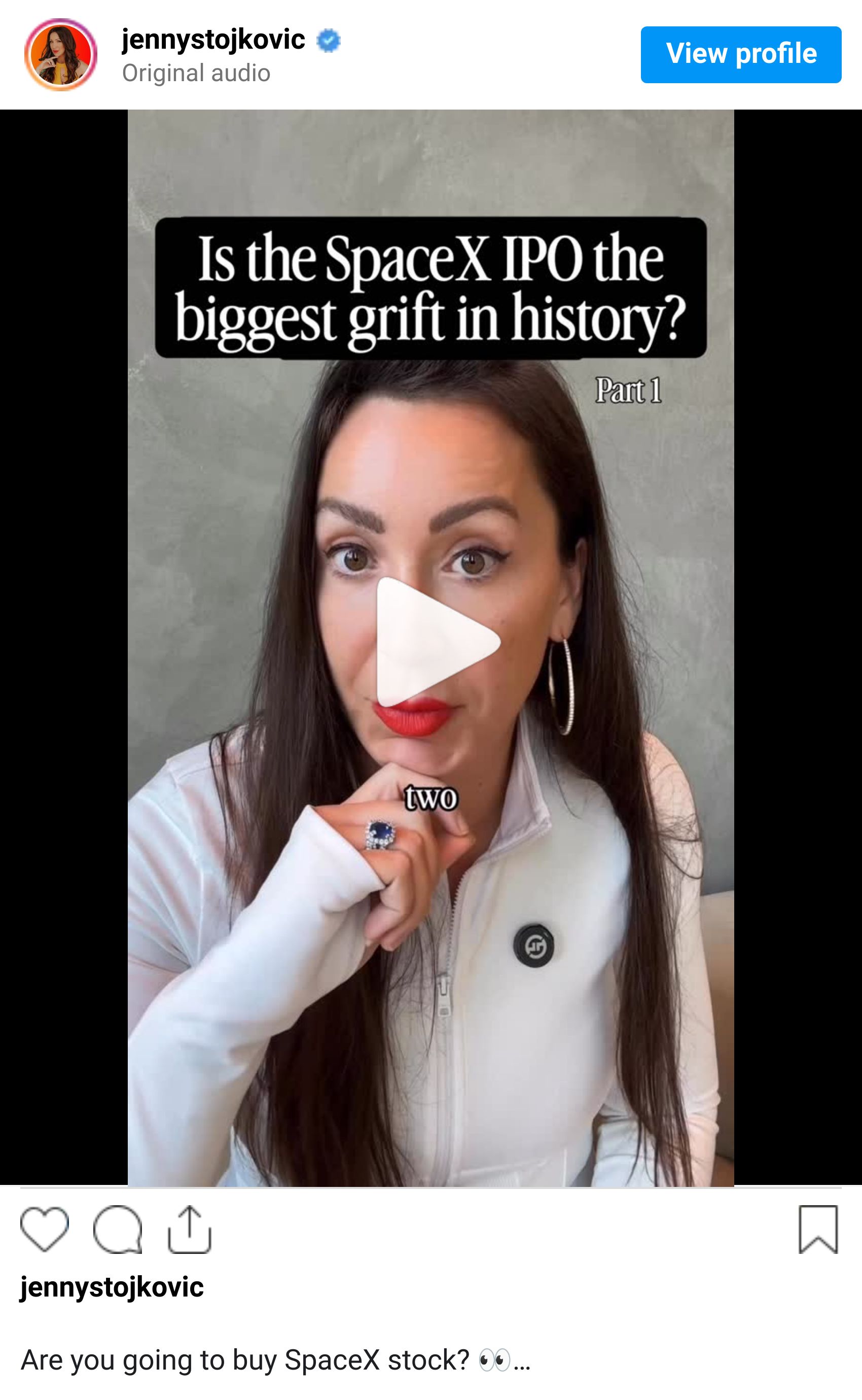
On June 12, SpaceX goes public at a projected valuation of $1.75 trillion. Anthropic filed its confidential IPO paperwork on June 1 at a $965 billion valuation. OpenAI filed its S-1 on May 22 and is targeting a valuation between $852 billion and $1 trillion. Three of the most hyped companies in the world are going public at the same time. And if you have a 401(k), an IRA, or any kind of broad index fund, you are about to own pieces of all of them, whether you asked for it or not.
“But wait, Jenny. Didn’t you say index fund companies were battle-tested!?”
Yeah, so here’s the thing…
The rules were rewritten to make this happen.
Index funds don't pick stocks. They track an index, and when a company gets added, the fund buys it, automatically, at whatever price is set that day. You have no input on timing, no input on valuation, no way to opt out while keeping your index exposure.
Historically, there was a buffer. Companies typically had to wait months, sometimes a full year, after going public before qualifying for major index inclusion. That window gave markets time to find a real price and gave passive investors some separation from the mania of day one.
In May 2026, Nasdaq updated its Nasdaq-100 methodology with a new Fast Entry rule: any newly public company large enough to rank in the index's top 40 by market cap can be added after just 15 trading days. SpaceX now qualifies.
S&P Dow Jones is in active consultation on a parallel overhaul. Their proposal would reduce the seasoning period from 12 months to 6, waive the four-quarter profitability requirement entirely for megacaps above $112 billion, and eliminate the minimum float requirement. None of these three companies are currently profitable. Under existing rules, not one of them would qualify for S&P 500 inclusion. Under the proposed rules, they all would.
Fortune published its verdict on June 2nd: investors won't benefit from the rule changes. The companies will.
Now let’s talk about the numbers.
SpaceX reported $18.7 billion in total revenue for 2025. At a $1.75 trillion IPO valuation, that is roughly 94 times last year's revenue. The aerospace and defense sector trades at an average of 13.8x EBITDA. Morningstar puts SpaceX's implied EBITDA multiple at 156x.
The entire bull case rests on Starlink, building data centers in space, and colonizing Mars.
But 94x revenue for a company in aerospace, with meaningful regulatory exposure and a single founder concentration risk, is a price that assumes everything goes right forever.
Anthropic crossed $47 billion in annualized revenue this year, up from $10 billion last year. The growth is genuinely staggering. Its $965 billion valuation puts it at roughly 20x that current run rate, which sounds more reasonable until you remember the run rate was $10 billion twelve months ago and any deceleration breaks the math completely.
OpenAI is generating about $24 billion in annualized revenue as of Q1 2026. It is valued at $852 billion to $1 trillion, or roughly 35 to 41 times trailing revenue. It is also losing $14 billion this year. For every dollar of revenue OpenAI brings in, it spends $2.22. The company does not expect to reach profitability until around 2030. Bridgewater's Greg Jensen told clients the implied multiple is "priced for a monopoly outcome that does not yet exist."
We have seen this movie.
The argument for buying into any of these IPOs is that they are different. That the size of the opportunity justifies the multiple. That this time is a unique moment in history. That is always the argument.
Rivian went public in 2021 at a valuation that briefly topped $100 billion. The company had delivered 156 vehicles. Today it is down 91% from its post-IPO highs. WeWork was valued at $47 billion before its IPO paperwork became public. By November of that same year, the market had repriced it to $8 billion. Lyft and Uber went public with transformational narratives, and neither has sustained anything close to its IPO-day valuation for any meaningful stretch of time.
What those companies shared was not fraud or fake products. They had real customers, real revenue, and real growth. What was unreal was the price tag on day one.
But to be fair, the inverse is also true. It’s comical to think about the narratives around companies like Meta, Nvidia, Apple, and Amazon today. Early stumbles pale in comparison to all the wealth they’ve generated over the last 10 years.
The difference this time is scale, and that scale is exactly what makes the forced-buying mechanism so consequential. Analysts estimate $15 billion to $30 billion in mechanical index-fund buying in the months after SpaceX's inclusion, with aggressive float-weighted scenarios running above $200 billion across the broader passive ecosystem. Passive investors don't get to wait for a better price. They buy when the index buys, at the price the index pays that day.
Where I think we’re headed.
If you have money in a broad index fund, a total market fund, or a target-date retirement account, you will own SpaceX. You will likely own Anthropic. If OpenAI lists on schedule, you'll own that, too. None of this requires a single decision on your part.
If you want to make an active decision, the question isn't whether these companies are real. They are. Starlink is a legitimate global infrastructure business. Anthropic just posted its first profitable quarter. OpenAI has the most recognizable consumer AI brand in the world. The question is whether the price being set on IPO day reflects a business or a dream, and whether you're getting any say in the answer.
Here’s my problem with the whole thing. I love making risky bets and taking big swings, but that’s not what my passive index fund investing is for. I’ve written in the past that I do, in fact, think we are in a massive AI bubble. That doesn’t mean I think AI will fail. I think AI will transform our civilization.
But we’re gambling with people’s retirement. The average person saving for a comfortable future are now the exit liquidity for SpaceX, Anthropic, and OpenAI stockholders.
Maybe this time is different. Maybe AI is so profoundly transformational that there is no bubble, and we’re heading towards a future filled with wealth and prosperity.
What do you think?
I want to hear your hot takes on this issue. I read every reply.
Jenny
P.S. Know someone with a strong opinion on these IPOs? Forward this to them.

Shared this email? Subscribe here.