
In partnership with

Welcome to Billion Dollar Energy. I went from a farm town in Canada to a Silicon Valley insider and venture capitalist. I share secrets and insights to help you build wealth, legacy, and freedom.
Forwarded this email? Join 50,000+ other professionals every Wednesday.
Billion Dollar Energy is brought to you by:

Your inbox is full. Slack is piling up. Client messages need a response yesterday. Typing thoughtful replies to all of it takes hours you don't have.
Wispr Flow turns your voice into clean, professional text you can send the moment you stop talking. Speak like you would to a colleague — tangents and all — and get polished output. Emails, Slack, LinkedIn, WhatsApp, whatever's open.
89% of messages sent with zero edits. Used by teams at OpenAI, Vercel, and Clay. Works on Mac, Windows, and iPhone.
Thanks for joining our first-ever billion dollar walk!
We had an awesome time at last week’s first-ever billion dollar walk in Santa Monica. We had a diverse group of subscribers come out — CEOs, authors, investors, scientists, Hollywood producers, and much more.
But what did we all have in common? We all have billion dollar energy. 😉

Reply back to get on the waitlist for our next event.
Do you want to learn AI in the next 30 days?
I’m launching a 30 day Women’s AI Challenge this Friday with other top women creators in AI. We’ll teach you everything you need to know in only 30 days for free — plus you can win prizes just for participating from sponsors like Airtable, Manus, Stan, Anything, and more! All are welcome.
Being married to an HR executive has its perks. As a VC, I often get a glossy version of what’s going on inside a company, but the real tea? That always comes from the HR executive.
Over the years, my husband Pav has worked inside countless startups — and has seen the ones that embrace transformation and the ones that collapse. The difference is almost never what you'd expect.
Success has very little to do with process, initiatives, capital raised, or the quality of the product or service. At the end of the day, it all comes down to mindset.
And the organizations that don't have the right mindset are running out of time.
Recently, Pav was working with a company that claimed they wanted radical change in order to become an AI company. He came home one day and told me, “they’re not going to make it.”
So this week, I’m bringing back Pav so we can share our combined thoughts on what to look for in companies that won’t make it through the age of AI.
The numbers are damning.
80% of AI projects fail to deliver their intended business value. MIT just reported that 95% of generative AI pilots are stalling. The technology works, but the organizations deploying it have no idea how to go about facilitating the change required to adopt it. The average large enterprise loses $7.2M per failed initiative. They abandoned 2.3 initiatives in 2025 alone.
Fundamentally, this is a leadership problem.
And the latest proof is in the most unexpected place.
A new survey found that 44% of Gen Z workers are actively sabotaging their company's AI rollout. Employees are deliberately entering bad data, generating low-quality outputs to make AI look ineffective, and refusing to engage with platforms their companies mandated.
Easy to write this off as entitlement. That would be the wrong read.
These are your youngest, most digitally native employees. They are the ones who grew up with this technology, and they're voting no with their behavior. When 44% of that group is actively working against your biggest strategic initiative, they are not the problem. They are the symptom. The problem is how it's being rolled out.
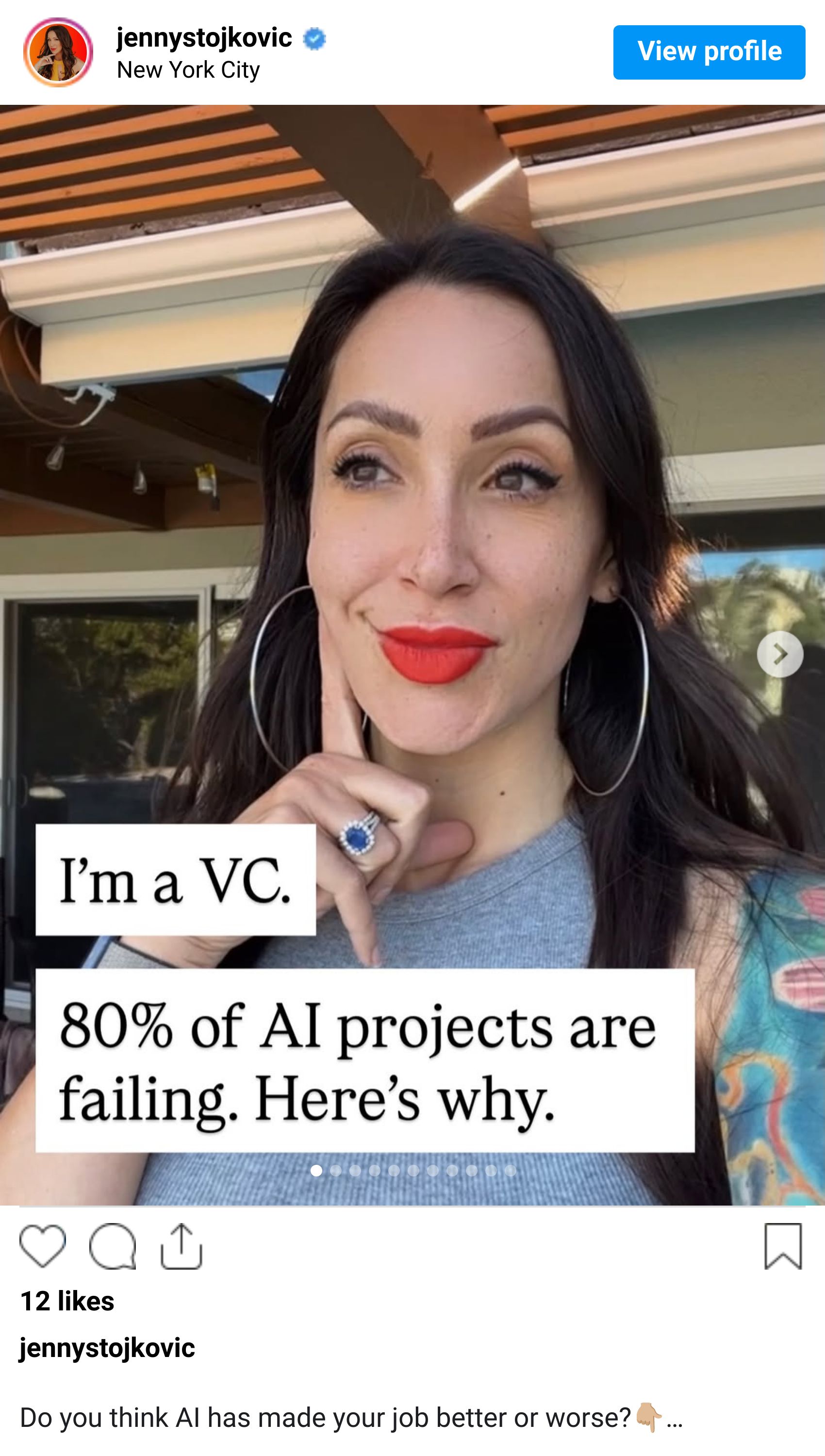
There’s an unfortunate irony here. The workers resisting AI are actually more likely to get cut than the ones who embrace it. But that's what happens when fear replaces trust. Everyone loses.
Pav shared these six red flags to look out for:
1. Leaders confuse attacking the problem with a personal attack.
Transformational change requires ego off the table. If your leaders are spending their time managing feelings instead of solving problems, the hard conversations never happen and nothing changes. Taking an organization through a real shift means putting your ego aside every single day.
2. Leaders confuse office politics with strategy.
Gossiping, maneuvering, talking about people behind their backs. AI doesn't care who's in whose corner. Teams that burn energy on office politics are in for a rude awakening when they realize the scoreboard has completely changed, and none of that positioning mattered.
3. Leaders confuse “shooting from the hip” with decisive action.
Moving fast without thinking is just making expensive messes faster. Inexperienced leaders take pride in looking decisive, but their teams spend half their time cleaning up what no one planned for. Speed without judgment is not a competitive advantage.
4. Leaders manage from a distance and call it delegation.
AI is going to flatten organizations. Layers of management that exist to coordinate other layers of management are already being eliminated. Real leaders know their departments’ inner workings and charge into battle with their people. They don't watch from the 30th floor.
5. Leaders build fiefdoms instead of encouraging transparency and collaboration.
This one is rooted in fear. When everyone is protecting what's "theirs," change is slow and ineffective. The companies that win in the age of AI will be the ones where information moves freely and people trust each other enough to share it.
6. Leaders confuse being busy with being productive.
These are companies where everyone is in back-to-back meetings, working nights, and spending weekends trying to catch up. And somehow, nothing moves. Every single red flag above leads here. Busyness is what organizations retreat to when they don't know how to change, and it is a very convincing disguise for standing still.
Here’s the takeaway.
Gone are the days of cheap money and protective moats. The companies quietly rehiring human agents after their AI pilots failed didn't have a technology problem. They had a leadership problem. And they paid for it.
If your company has some or all of these flags, the next 12 months are going to be difficult. Not because AI is coming for you, but because the window to get your house in order is closing.
The good news: culture can change. But only when someone at the top decides they care more about the mission than their ego.
It's time to grow.
Hit reply and tell me which of these flags shows up most in your experience? I read every single response.
Jenny
P.S. If this landed, forward it to a leader in your life who needs to hear it. The coachable ones will thank you.

Shared this email? Subscribe here.