
Welcome to Billion Dollar Energy. I went from a farm town in Canada to a Silicon Valley insider and venture capitalist. I share secrets and insights to help you build wealth, legacy, and freedom.
Forwarded this email? Join 55,000+ other professionals every Wednesday.
Billion Dollar Energy is brought to you by:

As a special thank you to billion dollar energy subscribers, get three months of Wispr Flow free from me today!
If I asked you what the biggest story from last night's midterms was, you'd probably name at least one of the six women in the wave who swept last night’s election. But what if I told you there's an even bigger wave right behind them?
Last night, women rewrote 250 years of American history. Democrats and Republicans, six different states, and six historic firsts.
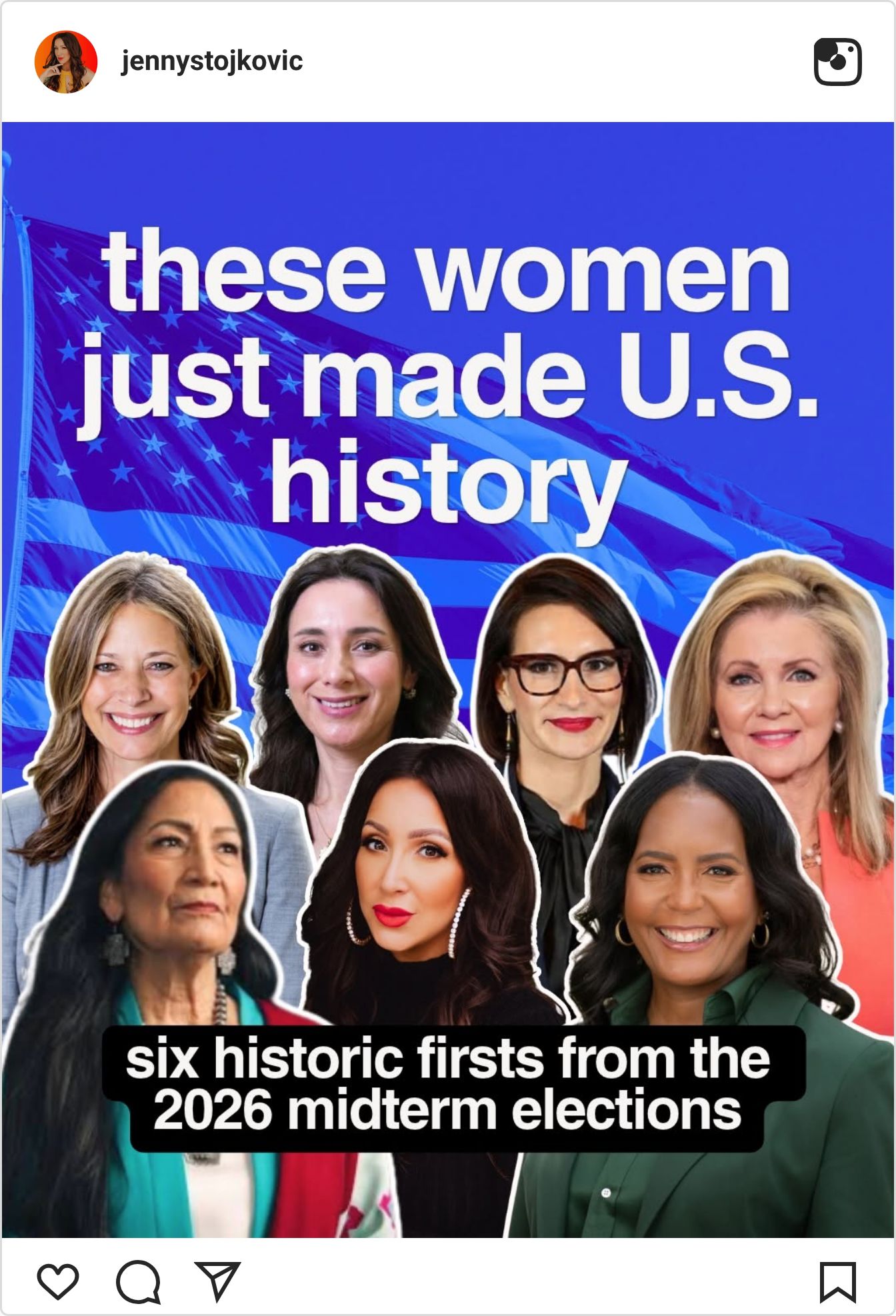
Meet the women leading the future of American politics.
Keisha Lance Bottoms is Georgia's Governor-elect and the first Black woman elected governor in U.S. history. ABC News projects she defeated Republican Rick Jackson in a state Donald Trump won in 2024.
Deb Haaland is New Mexico's Governor-elect and the first Native American woman elected governor in U.S. history. In her victory speech she called it "the honor of my lifetime."
Gina Hinojosa is Texas's Governor-elect and the state's first Latina governor. She defeated Greg Abbott by about seven points, according to NBC News' tally.
Amy Acton is Ohio's Governor-elect and the first woman elected to lead the state. She defeated Vivek Ramaswamy and will also be Ohio's first Jewish governor.
Peggy Flanagan is Minnesota's U.S. Senator-elect and the first Native American woman elected to the U.S. Senate. The AP called her race against Michele Tafoya just after midnight.
Marsha Blackburn is Tennessee's Governor-elect and the first woman elected governor of the state. She beat Democrat Jerri Green in Tennessee's first all-woman race for governor, so a woman was going to win either way.
Different states, different backgrounds, and different political beliefs. But each of them is a first.
Here's what I find fascinating. Women have had the constitutional right to vote nationwide for just over 100 years. We're still watching women become the first to hold some of the most powerful jobs in America. Whichever party you support, these milestones are worth recognizing, because you can't be what you can't see.
Now follow the money.
Campaigns run on money, so I went looking for how women give.
Rutgers' Center for American Women and Politics tracks every dollar given to congressional candidates. Its latest numbers show women make up about 56% of individual donors this cycle, up from 52% in 2024. But women have given only 41% of the money, up from 37%.
So more women give than men, but they give smaller checks. The split by party is wide, too: women gave 46% of the money going to Democratic candidates and 30% of the money going to Republicans.
Women already show up. The gap is in check size, and check size follows wealth.
That gap is closing faster than most people realize.
The bigger wave is women billionaires.
Forbes counted a record 43 self-made women billionaires in America this year. McKinsey projects that US women will control $34 trillion in wealth by 2030, up from $7.3 trillion a decade earlier.
What I find most interesting is how these women are choosing to use their money.
Melinda French Gates doubled a pop star's fundraiser. In August, Olivia Rodrigo's first Daisy Chain Fields festival raised $10 million for nonprofits serving women and girls. French Gates came on stage and matched every dollar through Pivotal, bringing the total to $20 million. I made a video about it at the time, because it showed something I see constantly in venture: creatives can bring people together, and tech money can speed up the impact. Put the two in the same room and the numbers double overnight.
Gwynne Shotwell is giving SpaceX stock to 2 million kids. Shotwell joined SpaceX as employee number 11 in 2002 and now runs it as president and COO. The IPO made her stake worth more than $2 billion. She and her husband, Robert, are giving over 2 million SpaceX shares to the Trump Accounts of 11- to 17-year-olds in lower-income ZIP codes, one share per kid, with distribution set for December. If you read my issue on Trump Accounts, this is exactly the kind of outside money those accounts were built to receive.
Melanie Perkins is giving most of Canva away. Perkins and her cofounder and husband, Cliff Obrecht, signed the Giving Pledge in 2021 and committed more than 80% of their wealth to the Canva Foundation. The foundation has given more than $80 million through 2025, including over $50 million toward a $150 million pledge to end extreme poverty in Malawi.
The biggest one hasn't happened yet. Anthropic filed to go public on October 26 and plans to list on the Nasdaq as ANT. Reports put its target valuation as high as $2 trillion. I believe it will be the largest wealth creation event we've ever seen. Daniela Amodei, Anthropic's cofounder and president, was already worth an estimated $15.5 billion before the IPO. She and her six cofounders have pledged to give away 80% of their wealth.
My take.
For most of American history, the biggest checks in politics came from men because the biggest fortunes belonged to men. Women have been the majority of donors for years. What they lacked was the balance sheet.
That's changing one IPO at a time.
None of the women I just mentioned has said she'll spend her fortune on campaigns. Their pledges point to philanthropy. But look at the pattern: women who reach this level of wealth tend to give big, give early, and fund causes they want to see move. When a few of them decide elections are one of those causes, the math changes.
Women's share of political dollars jumped four points in a single cycle. If it keeps climbing while this new class of wealth comes online, 2028 could be the first presidential election where women fund as much of the race as men do.
In fact, women could very well vote in – and fund – the next President of the United States.
Last night showed what happens when women run. The next few years will show what happens when women fund.
Hit reply and tell me: if you had a billion dollars to give away, would any of it go to politics? I read every single response.
Jenny
P.S. Want to see who's funding your own representatives? Look up your senators and your member of Congress on OpenSecrets. It takes two minutes, and the names on the donor list may surprise you.

Shared this email? Subscribe here.