
Welcome to Billion Dollar Energy. I went from a farm town in Canada to a Silicon Valley insider and venture capitalist. I share secrets and insights to help you build wealth, legacy, and freedom.
Forwarded this email? Join 55,000+ other professionals every Wednesday.
Billion Dollar Energy is brought to you by:

As a special thank you to billion dollar energy subscribers, get three months of Wispr Flow free from me today!
This issue includes my recap from Oktane 2026, in partnership with Okta. Opinions are my own. #OktaPartner #Oktane26
Imagine your customer asks an AI assistant to reorder groceries from your store. It does. It also quietly adds a $100 gift card to the cart and sends it to an email address your customer has never seen. Nobody stole their card number or guessed their password. A robot just used a real customer's credit card to buy something they never asked for.
Security researchers at Palo Alto Networks' Unit 42 have already outlined how a shopping agent could get tricked this way. Hidden instructions on a website could turn an ordinary errand into a fraudulent purchase. For your business, that could mean an order to untangle and a customer wondering whether to trust you again.
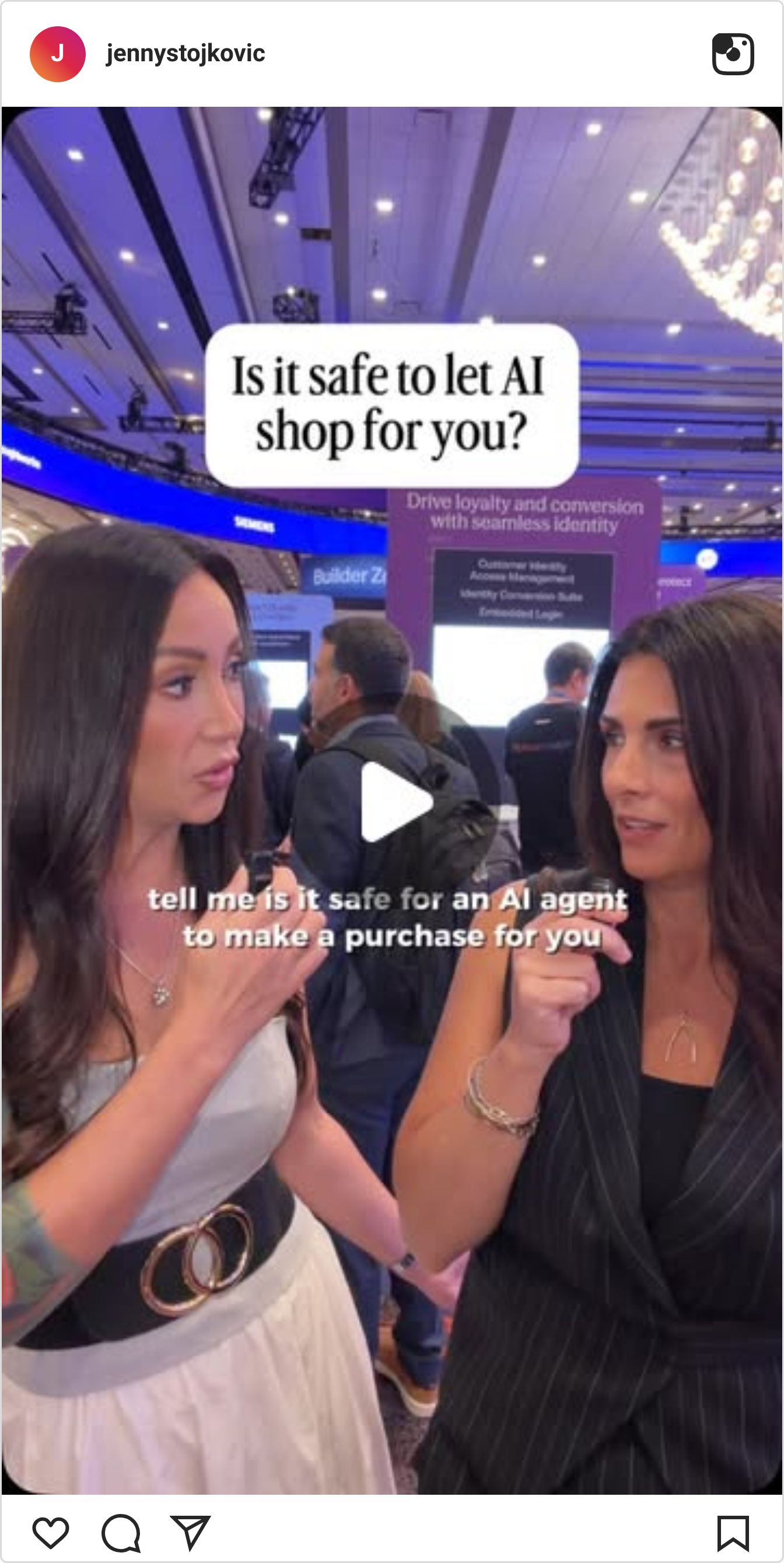
At Oktane in Las Vegas, that was the question behind my conversations: if an AI agent shows up ready to buy, how do you know who sent it and what they actually approved?
Stick around to the end for two things: my bet on who'll use these agents the most, and what that means for the businesses they buy from.
The robots already have shopping carts.
According to Adobe, traffic from AI sources to US retail sites grew 393% year over year in the first quarter of 2026. In March 2025, those visits converted 38% worse than non-AI traffic. By March 2026, they converted 42% better. That's a full reversal in twelve months.
Those numbers measure visits referred by AI tools, not purchases completed autonomously by agents. But if you sell online, they're a good reason to look at how AI is already bringing customers to your business.
So, who's actually buying from you?
The old version of identity theft was simple: someone stole a customer's password, logged in as them, and bought a TV. The new version has an extra layer. When an agent shows up at checkout, your store has to answer two questions at once. Is this a legitimate agent? And did the customer actually tell it to buy this?
The gift card scenario shows why both questions matter. A legitimate agent can still get manipulated into doing something its customer never intended. Recognizing the software doesn't tell you everything about what it's allowed to buy.
I spent time in Vegas with the people building the ID check.
If the fraud problem in agentic shopping is "who is actually buying this," identity companies are the ones who have to answer it. That's why I flew to Oktane, Okta's annual identity conference.
I was especially interested in Auth0, the part of Okta that helps stop fraud behind the scenes and keeps users recognized across every touchpoint. When your customers send agents to shop, that work also means recognizing the person behind the software and understanding what they've allowed it to do.
One question kept coming up at Oktane: how do we give AI agents enough freedom to be useful while keeping people in control?
Here's what I took away.
1. AI agents are real shoppers.
Blocking every bot gets complicated when some of them are trying to buy from you. Gareth Davies, Chief Product Officer at Auth0, put it this way: "If you're not building for agents as first-class citizens as shoppers, you're going to miss out on business." Auth0 announced AI Identity for Commerce, designed to help businesses verify customers and support secure transactions through third-party AI assistants like ChatGPT.
His advice for business owners still on the fence: "Just look at your analytics."
2. The customer relationship is up for grabs.
When an agent does the shopping, it sits between your business and your customer. It picks the product, compares the prices, and checks out, and the customer may spend less time on your site. I asked Okta's CMO, Shannon Duffy, whether agents could end up stealing a brand's customers. "Could they? Sure. Will they? I don't think so. And I think smart CMOs won't let that happen."
Her answer for how: "Identity is not a login box. Identity is sacred." Your customer should still be able to come back to a familiar account and a brand they trust, even when software handles the errand.
3. The opportunity depends on trust.
Shannon described the opportunity this way: "Think of having all these new sales reps, these new brand ambassadors unleashed."
But a customer still has to be comfortable letting software spend their money. If the first agent-assisted order leaves them wondering what they approved, you've given them a reason to hesitate the next time.
4. Your customer's agent needs boundaries, too.
One takeaway from the Auth0 conversations at Oktane: knowing who the customer is is only half the job. Your business also needs to know what they've allowed their agent to do. "Reorder my groceries" and "buy whatever you want with my card" should never mean the same thing.
Here's my actual take.
I'd bet the biggest users of AI shopping agents end up being women.
Think about the mental list running in the background: the groceries that are running low, the gift for Saturday's birthday party, the dog food refill.
That invisible list is exactly what agents are built for. For most women I know, the pitch is simple: one less thing to remember.
For business owners, that's a reason to look closely at everyday repeat purchases. An agent that helps a customer keep buying from a brand they trust could become part of that relationship. But the customer has to trust it enough to come back.
That's the opportunity for the businesses reading this: make it easier for customers to buy from you without making them wonder who is in control of the purchase.
Hit reply and tell me: what's the biggest unanswered question about AI shoppers in your business? I read every single response.
Jenny
P.S. If you run a business that sells anything online, ask your team one question this week: can our site tell a real customer's agent apart from a bot pretending to be one?

Shared this email? Subscribe here.